
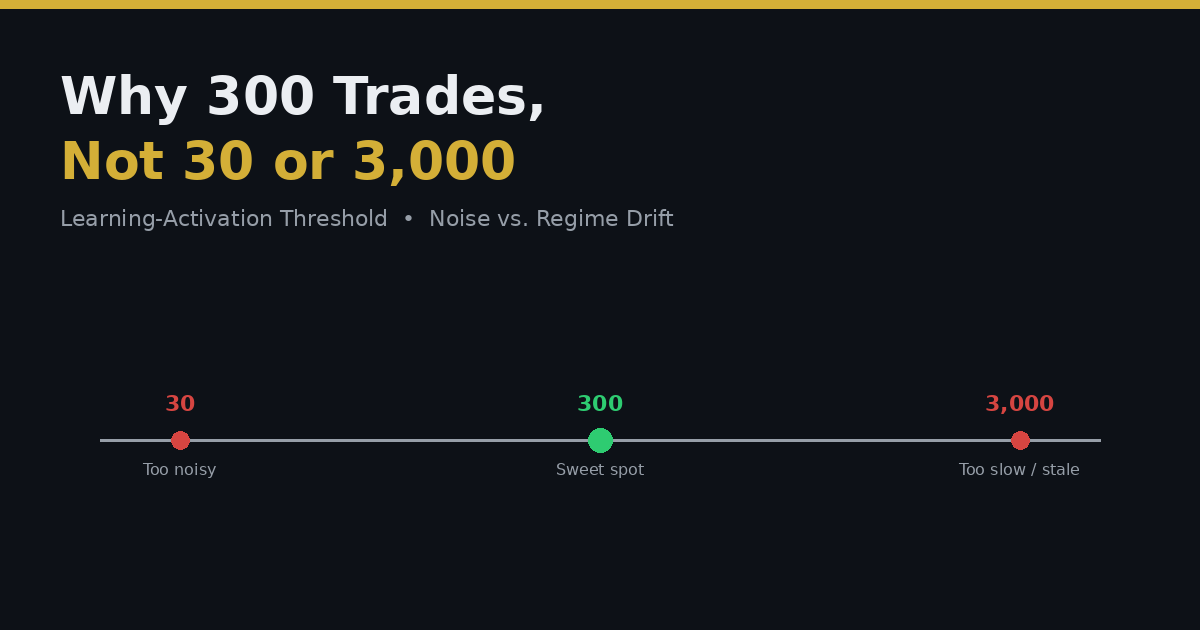
A self-learning EA's Phase A/Phase B design raises an obvious question: why 300 trades specifically, before the adaptive Phase B logic activates? Not 30, not 3,000. The number isn't arbitrary, but it's also not derived from a rigorous statistical formula — it's a practical compromise between two competing risks that every learning-activation threshold has to balance.
The Risk of Too Few Trades: Noise Looks Like Signal
With a small sample — say, 30 trades — win rate and expectancy numbers swing wildly based on a handful of outcomes. A EA that happens to catch four or five lucky trades early could show an 80%+ win rate that has nothing to do with the underlying strategy's real edge, purely because 30 trades isn't enough for the variance in outcomes to average out. Activating adaptive behavior on a sample that small risks the Learning Engine "learning" a pattern that's really just short-term noise, then confidently adjusting future confidence scores based on that noise.
The Risk of Too Many Trades: Waiting Forever, and Regime Drift
The opposite failure mode is requiring an unreasonably large sample — 3,000 trades, for instance — before allowing any adaptation. On a symbol like XAUUSD, accumulating that many completed trades could take a very long time, especially during the data-collection phase when the EA is deliberately running conservative, unoptimized baseline logic. Beyond the sheer wait, market conditions don't hold still — volatility regimes, typical spread, and broker execution behavior all shift over time. A threshold set high enough to guarantee statistical rigor risks training on a dataset that spans multiple different market regimes, diluting what the Learning Engine can actually infer about current conditions.
Why 300 Lands in a Reasonable Middle Ground
300 trades is large enough that win rate and profit factor stop swinging wildly with each new outcome — the law of large numbers starts to meaningfully smooth out individual-trade variance well before this point for a strategy generating a reasonable number of wins and losses. It's also small enough to accumulate in a practical timeframe on an actively-trading symbol, and short enough that the underlying market conditions are less likely to have shifted dramatically compared to a multi-thousand-trade collection window. It's a pragmatic threshold, not a mathematically proven optimal one — chosen because it clears the "obviously too noisy" bar without falling into the "impractically slow, and possibly stale by the time it's reached" trap.
What This Threshold Doesn't Guarantee
Reaching 300 trades doesn't mean the resulting statistics are free of bias — it just means the sample is large enough that pure random variance is less likely to dominate. If the 300 trades collected happen to span an unusually trending or unusually choppy period for that symbol, the Learning Engine will still be adjusting based on a sample that may not represent "typical" future conditions. This is exactly the kind of judgment call that has no clean answer — a fixed trade-count threshold is a proxy for "enough data," not a guarantee of representative data, and it's worth treating the Phase B activation point as "reasonably ready to adapt," not "statistically certain to be correct."
Why This Connects to Discarding Contaminated Backtests
This threshold reasoning is the same underlying logic that made scrapping a contaminated 182-trade backtest the right call rather than patching it mid-run: a threshold like 300 trades is only meaningful if every trade counted toward it is a clean, correctly-classified data point. A sample size chosen specifically to avoid being fooled by noise loses its entire purpose if a portion of that sample is itself corrupted by a logging or classification bug — which is exactly why identifying and fixing a Learning Engine bug means restarting the count from zero, not just correcting the calculation going forward.
Related Reading
- SuperTrend Martingale EA for XAUUSD: Phase A/B Self-Learning Engine Explained (MT5)
- Why We Scrapped a 182-Trade Backtest Instead of Patching It: A Contaminated-Training-Data Lesson
- Inside a Self-Learning MT5 EA's 8-Factor SMC Confidence Score (and a Learning Engine Bug)
- Managing a 4-Timeframe, 5-Indicator Stack and Broker-Safe Pip Math in an MT5 EA


.png)
0 Comments