
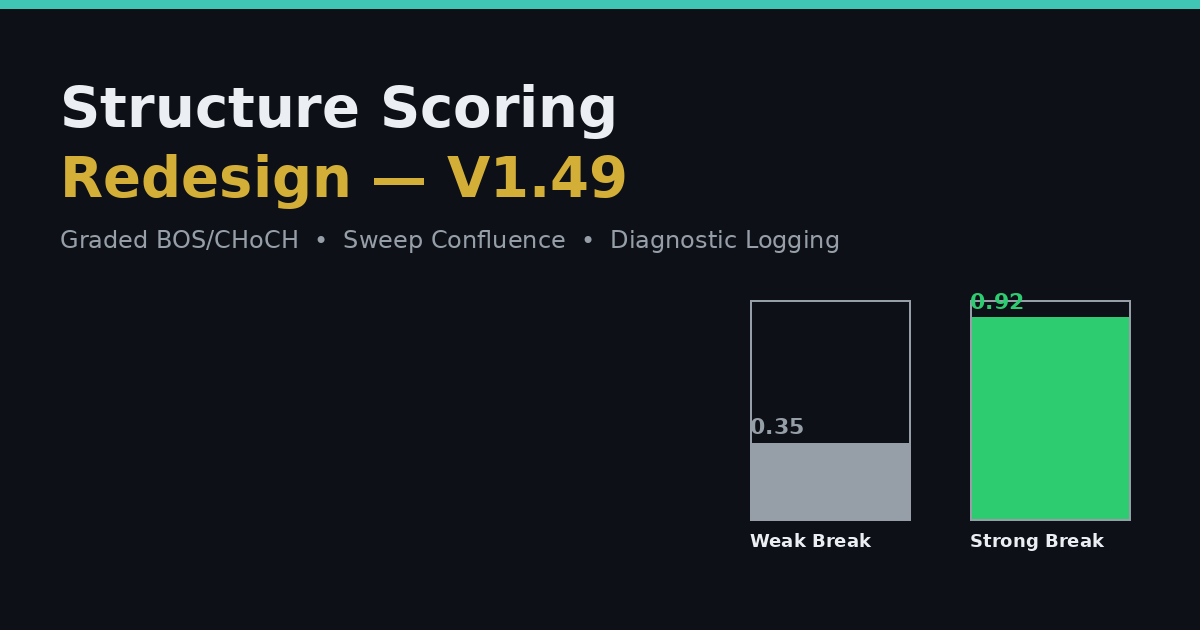
A confidence-scoring EA is only as good as the inputs feeding each category. The original Structure and SMC scoring in a modular self-learning MT5 EA treated every Break of Structure (BOS) or Change of Character (CHoCH) the same way — a clean break scored exactly the same as a barely-there break. Version 1.49, the "Structure Scoring Redesign," addressed that with three opt-in flags that let the scoring engine tell a strong structural break from a weak one, without changing any of the existing default behavior.
Problem: All Structure Breaks Scored Equally
In the original scoring logic, a BOS or CHoCH contributed a fixed value to the Structure category — 0.85 for one type of break, 1.0 for another — regardless of how decisively price actually broke the level. A break that closed a few points past a swing high scored identically to one that closed with strong momentum well beyond it. That's a meaningful loss of information: a barely-confirmed break is a weaker signal than a decisive one, but the original scoring couldn't tell them apart.
Fix 1: Graded Structure Scoring (InpUseGradedStructure)
This new opt-in flag grades BOS/CHoCH strength by how far price broke past the structural level, normalized against ATR — so the same break distance means something different in a low-volatility environment than a high-volatility one. Instead of the fixed 0.85/1.0 values, the score scales with how convincingly the break happened. Default is off, so existing behavior is unchanged until a trader explicitly opts in.
Fix 2: Requiring Sweep Confluence (InpRequireSweepConfluence)
A liquidity sweep on its own is a common and often noisy signal — price can spike through a liquidity pool and reverse for reasons that have nothing to do with a genuine institutional move. This flag adds a confluence requirement: a liquidity sweep only counts toward the SMC score if an order block or fair value gap is also present on the same bar. This filters out sweeps that occur in isolation, keeping only the ones that align with another SMC structure at the same moment — a stronger combined signal than either one alone.
Fix 3: Diagnostic Score-Breakdown Logging (InpLogScoreBreakdown)
Tuning eight weighted scoring categories is difficult without visibility into how each one actually behaves across real trades. This flag writes a per-signal breakdown of every score component to a separate diagnostic CSV — entirely separate from the main learning CSV, so it never touches or interferes with the Learning Engine's feedback loop. It exists purely for the trader's own analysis of which categories are driving (or dragging down) the total score over time.
The Testing Methodology: Isolate Before You Combine
Rather than turning all three new flags on at once, the testing plan runs in strict stages:
- Baseline first: Run with only
InpLogScoreBreakdownenabled and every other new flag left off, to collect a clean baseline dataset of how the existing scoring behaves. - One variable at a time: Toggle
InpUseGradedStructureon by itself and compare against the baseline. Then repeat forInpRequireSweepConfluencealone. - Compare, don't assume: Each flag's effect is measured against the same baseline data rather than guessed at, using the same before/after comparison approach used in earlier experiments on this EA (like the confidence-threshold and max-position-limit changes).
This isolate-then-combine approach matters specifically because the two scoring flags interact with different parts of the same combined score — turning both on simultaneously and seeing an improvement (or a regression) wouldn't tell you which change actually caused it, or whether they're offsetting each other.
Why Backward Compatibility Matters Here
All three flags default to false, meaning a trader running the EA without touching these inputs sees zero behavior change from this update. This is a deliberate design choice for any EA that's already collecting live learning data — introducing a breaking change to core scoring logic would invalidate the trade history the Learning Engine has already accumulated. Opt-in flags let the new scoring logic be tested in parallel without disrupting an EA that's mid-way through its own data collection phase.


.png)
0 Comments