
A confidence-scoring EA that reads Trend, Momentum, and Structure across four separate timeframes needs indicator data from all four at once — not just the chart it happens to be attached to. Getting this right in MT5 means managing a meaningful number of indicator handles simultaneously, and making sure a lot size or pip distance calculated on one broker's price feed doesn't silently break on another's.
The Four-Timeframe Stack, and Why Each Layer Exists
The IndicatorEngine module maintains indicator handles across four distinct timeframes, each serving a different analytical purpose: a higher-timeframe trend read (H4), a lower-timeframe trend read (H1), a confirmation timeframe (M15), and the execution timeframe (M5) where entries actually trigger. This isn't four copies of the same analysis — it's a deliberate hierarchy where a signal on the execution timeframe only matters if it doesn't contradict what the higher timeframes are showing.
Five Indicators, Times Four Timeframes
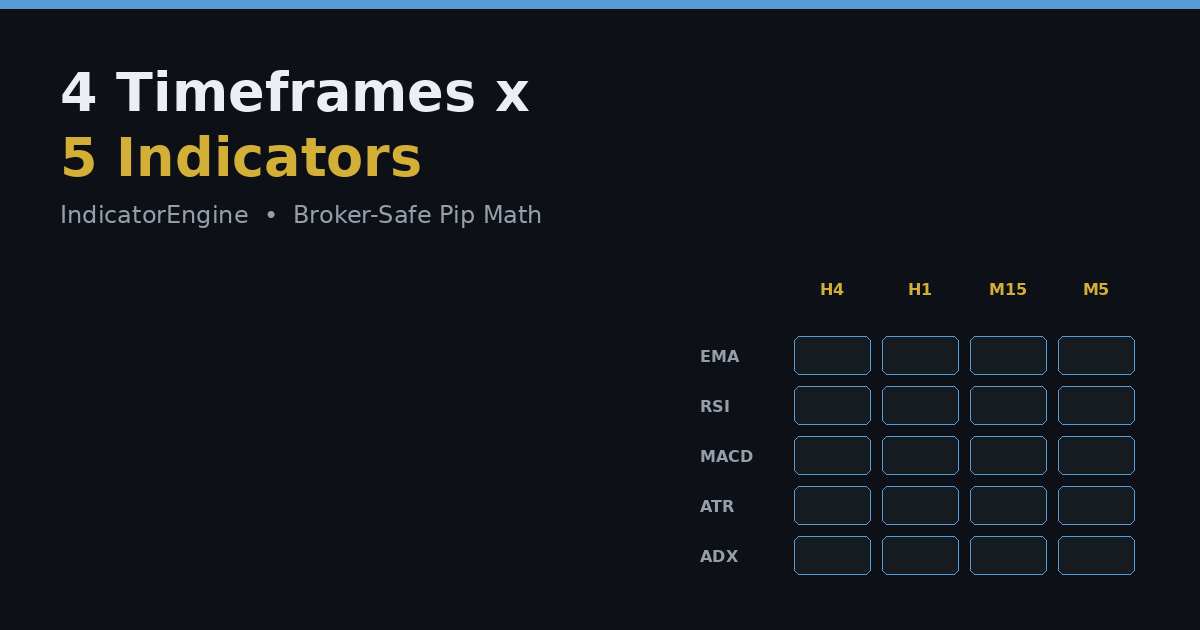
Across that four-timeframe stack, the engine maintains handles for EMA, RSI, MACD, ATR, and ADX — meaning, in the worst case, up to twenty separate indicator handles active simultaneously for a single symbol. Each of these feeds a different part of the scoring system: EMAs and ADX contribute to Trend and Momentum readings, RSI adds momentum confirmation, MACD provides its own independent momentum signal, and ATR feeds both the Volatility score and the risk-management calculations (stop-loss distance, graded structure scoring introduced in the V1.49 update). Managing this many handles cleanly matters because MT5 has practical limits on indicator handle creation, and handles created carelessly — say, inside a function called every tick instead of once at initialization — can exhaust those limits or silently degrade performance over a long-running EA session.
Broker-Safe Math: Why Pip Conversion Isn't as Simple as It Looks
The MathUtils module handles pip and point conversions in a way that's explicitly broker-digit safe. This matters because brokers don't all quote the same symbol with the same number of decimal digits — a 5-digit broker and a 3-digit broker (common for JPY pairs) represent the same price movement with different point values, and a calculation that assumes one digit convention will silently miscalculate stop-loss distances, lot sizes, or ATR-based thresholds on a broker using the other convention. An EA running across multiple accounts and brokers — as this system does, given its multi-symbol, multi-timeframe design — needs every distance-based calculation to detect and adjust for the actual broker's digit convention rather than assuming one universally.
Why This Kind of Plumbing Rarely Gets Attention
None of this — indicator handle management, broker-digit-safe math — produces a visible feature a trader would point to. It's the layer underneath every visible feature: the confidence score, the risk-managed exits, the structure detection, all depend on indicator values and distance calculations being correct and efficiently retrieved in the first place. A subtly wrong pip conversion doesn't usually cause an obvious crash; it causes stop-losses placed at slightly wrong distances or position sizes calculated slightly off, in ways that are easy to miss during casual testing and only show up as inconsistent behavior across different broker accounts.
A Practical Takeaway for Multi-Timeframe EA Development
Two habits are worth taking from this design: first, create indicator handles once during initialization and reuse them across ticks rather than recreating them repeatedly, both for performance and to avoid hitting MT5's handle limits. Second, never hard-code a pip or point value as a fixed number of decimal places — always calculate it from the symbol's actual digit and point properties at runtime, since the same EA logic may eventually run on a broker with different quoting conventions than the one it was originally tested on.
Related Reading
- Inside a Self-Learning MT5 EA's 8-Factor SMC Confidence Score (and a Learning Engine Bug)
- Grading Structure Breaks in an MT5 SMC EA: The V1.49 Structure Scoring Redesign
- Percentage-Risk Sizing and Correlation Filtering in an MT5 EA (No Martingale, No Grid)
- Why Session and News Filters Get the Lowest Weight in an MT5 EA's Confidence Score


.png)
0 Comments