
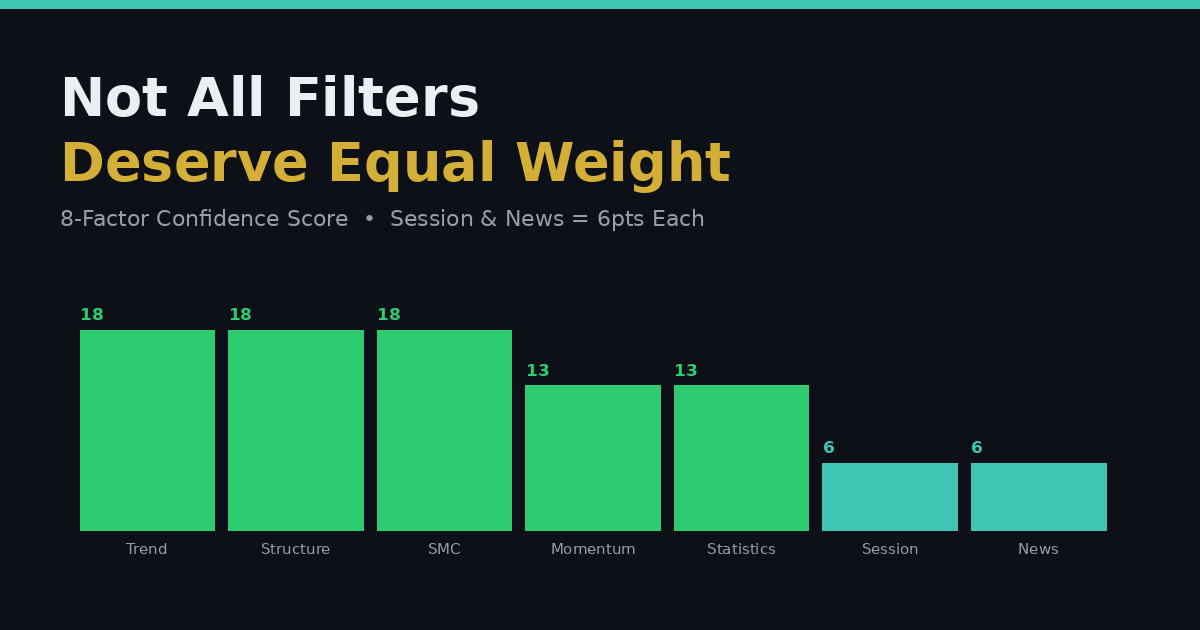
In an 8-factor confidence scoring system, Structure and SMC each carry an 18-point weight, while Session and News each carry only 6. That's not an oversight — it reflects a deliberate judgment about what these two factors can and can't tell you about whether a specific trade setup is good.
What the Session Filter Actually Detects
The SessionManager module identifies which trading session is currently active — Asian, London, or New York — based on server time. Session context matters because liquidity and volatility genuinely differ by session: the London/New York overlap tends to bring higher volatility and tighter spreads on major pairs, while the Asian session on the same instrument can be comparatively quiet. Knowing which session is active gives useful context about the kind of price action likely to unfold.
What the News Filter Actually Detects
The NewsManager module pulls from MT5's built-in Calendar API to identify high-impact economic news events before they happen, and filters out trade entries around those windows. High-impact releases (rate decisions, employment data, and similar) can produce sudden volatility spikes that have nothing to do with the technical setup an EA is trying to trade — a clean SMC or structure-based signal can get invalidated in seconds by a news-driven spike that no amount of chart analysis would have predicted.
Why Both Still Only Get 6 Points Each
Session and news context describe the environment a trade happens in — they say nothing about whether the specific setup in front of the EA is actually a good one. A session with typically high liquidity doesn't make a weak structure break into a strong one. A news-quiet window doesn't turn a low-quality SMC signal into a high-quality one. These two factors are better understood as risk-adjustment context than as signal-quality indicators, which is exactly why they sit at the bottom of the weighting scale, behind Trend (18), Structure (18), SMC (18), Momentum (13), and Statistics (13).
Put differently: Session and News answer "is this a reasonable moment to be trading at all," while Trend, Structure, SMC, and Momentum answer "is this specific setup actually worth trading." A confidence score dominated by the first kind of question would let a bot avoid news spikes and quiet sessions while still firing on mediocre setups during "safe" windows — exactly the wrong trade-off for a system trying to identify genuinely high-quality entries.
Configurable, Not Fixed
Like every other category in this scoring system, the Session and News weights are configurable inputs rather than hard-coded constants. A trader who's found through their own trade history that session timing matters more for their specific symbol and timeframe combination than the default 6-point weight suggests can adjust it upward — the point isn't that 6 is universally correct, it's that the default reflects a considered starting assumption about what these factors can and can't tell you, which a trader can then test and revise using their own Statistics category feedback.
The Broader Lesson: Not All Filters Deserve Equal Weight
It's tempting, when building a multi-factor scoring system, to treat every available filter as equally important simply because each one adds some information. The more useful design question is what kind of information each factor actually provides — a factor that filters out bad moments to trade is doing a genuinely different job than a factor that identifies which specific setups are worth trading, and conflating the two in the weighting scheme risks either drowning out real signal quality with environmental noise, or ignoring environmental risk that a strong signal alone can't overcome.
Related Reading
- Inside a Self-Learning MT5 EA's 8-Factor SMC Confidence Score (and a Learning Engine Bug)
- Grading Structure Breaks in an MT5 SMC EA: The V1.49 Structure Scoring Redesign
- Percentage-Risk Sizing and Correlation Filtering in an MT5 EA (No Martingale, No Grid)
- Why We Scrapped a 182-Trade Backtest Instead of Patching It: A Contaminated-Training-Data Lesson


.png)
0 Comments