
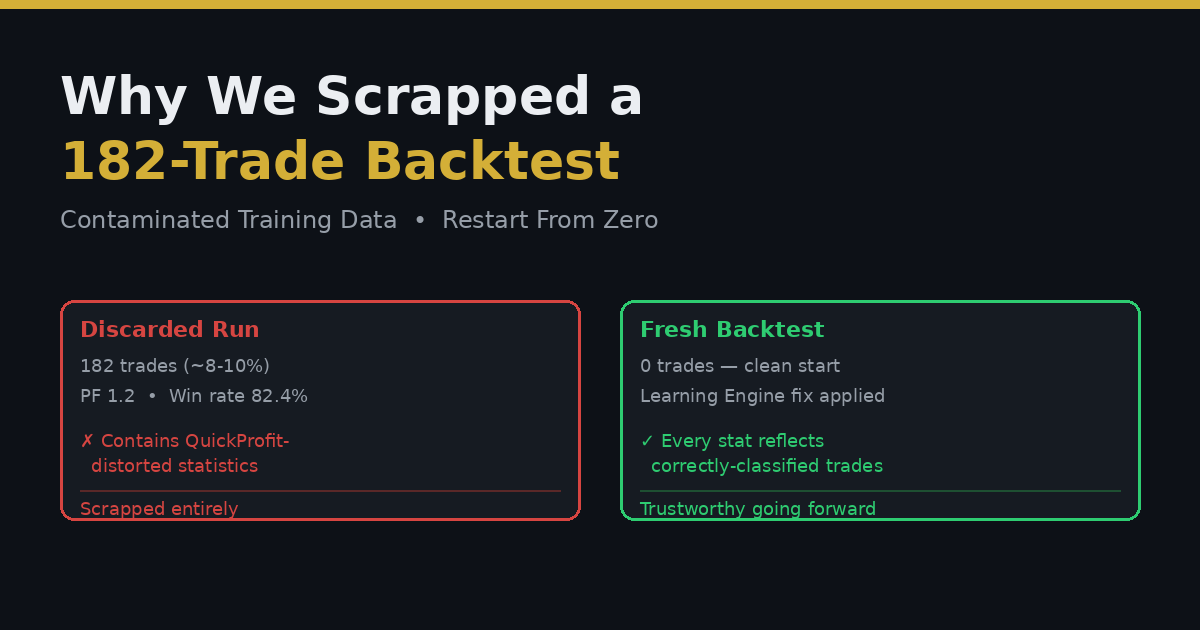
A backtest that's already 182 trades in, running at a 1.2 profit factor and an 82.4% win rate, looks like something worth protecting. When a fix to the underlying scoring logic landed partway through that run, the tempting option was to patch the fix in and keep the existing results going. The decision made instead was to stop the backtest entirely and restart from zero on the corrected version — a choice that only makes sense once you think about what a self-learning system's training data actually is.
What Was Running When the Fix Landed
The backtest in question had reached 182 completed trades — roughly 8-10% of the way through the intended full run — showing a 1.2 profit factor and an 82.4% win rate. Those numbers were generated before a fix to the Learning Engine's feedback loop: a "quick profit close" feature had been closing trades early, and those quick-exit trades were still being counted in the win-rate, profit-factor, and expectancy calculations the Learning Engine uses to adjust future confidence scoring.
Why Patching Mid-Run Doesn't Actually Fix Anything
The obvious shortcut would be: apply the fix, let the backtest keep running, and treat the first 182 trades as "close enough." The problem is that a self-learning EA's Learning Engine doesn't just report statistics — it uses the accumulated trade history to actively adjust future confidence scoring. By the time the fix landed, the EA had already made adjustment decisions based on statistics that included the distorted QuickProfit trades. Those adjustments don't reset just because the underlying calculation is now correct going forward — the EA's internal state at that point had already been shaped by contaminated numbers.
This is a fundamentally different problem than fixing a bug in, say, a dashboard display. A display bug only affects what you see; fixing it retroactively is fine because the underlying data was never wrong. A learning-feedback bug affects what the system decided to do differently as a result of bad data — and that decision history can't be cleanly un-made without starting the accumulation over.
The Decision: Discard and Restart, Not Patch and Continue
Rather than trying to reconstruct which specific confidence-score adjustments were influenced by the contaminated statistics, the entire 182-trade run was discarded, and a fresh backtest was started from zero on the corrected version. This throws away real backtest time and the appearance of progress, but it guarantees that every statistic feeding the Learning Engine going forward reflects only clean, correctly-classified trade outcomes.
A General Principle for Any Self-Learning or Adaptive System
The specific numbers here (182 trades, 8-10% completion, 1.2 PF, 82.4% win rate) are specific to this EA, but the underlying principle generalizes to any system that adjusts its own future behavior based on accumulated historical data: once you discover the accumulation process itself was flawed, the accumulated state is suspect, not just the most recent additions. Patching the bug going forward while keeping the tainted history is the more comfortable choice — it preserves the sunk time and the reassuring appearance of results already in hand — but it means every future decision is still partly built on the earlier bad data. Restarting is the only way to guarantee a clean causal chain between "what actually happened" and "what the system learned from it."
Why This Is Harder Than It Sounds in Practice
Discarding real progress is a genuinely uncomfortable decision, which is exactly why it's worth calling out explicitly rather than assuming it's obvious. There's a natural pull toward believing that 182 trades of "mostly fine" data is better than zero trades of guaranteed-clean data, especially once a strategy is already showing promising numbers. But for a system whose entire value proposition is that it adapts based on its own trade history, "mostly clean" training data is a much weaker guarantee than it sounds — every one of those quick-exit trades that got misclassified as a normal statistical outcome nudges the Learning Engine's internal adjustments in a direction that has nothing to do with how the strategy actually performs on real, fully-played-out trades.
Related Reading
- Inside a Self-Learning MT5 EA's 8-Factor SMC Confidence Score (and a Learning Engine Bug)
- Grading Structure Breaks in an MT5 SMC EA: The V1.49 Structure Scoring Redesign
- Drawing a Live Dashboard on an MT5 Chart: Canvas-Based Equity Curve and Confidence Gauge
- Consolidating Partial Closes and Fixing MT5's Double-Firing Bug in an EA's Trade Log


.png)
0 Comments