
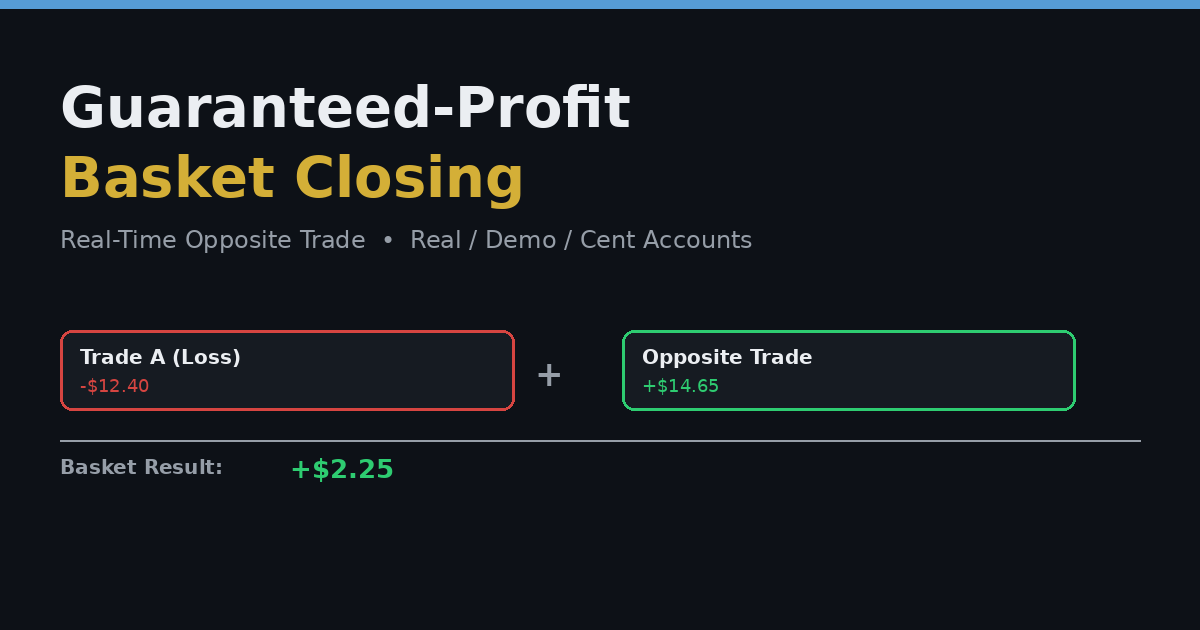
A stop-loss guarantees a maximum loss. It doesn't guarantee a profit, or even a break-even close, once a trade is already underwater. A safety-net mechanism built on top of a trend-filtered EMA crossover EA takes a narrower approach to that problem: rather than letting a losing trade run to its stop, it opens a single, precisely-sized opposite trade so that when both positions close together, the combined basket nets a small guaranteed profit — even if that profit is just a few cents.
The Core Idea: Basket Closing, Not Trade Rescue
The mechanism doesn't try to "save" a losing trade by predicting a reversal. It accepts the loss on that position as fixed, and instead solves a different, more mechanical problem: what size does the opposite trade need to be so that closing both positions together, right now, nets a small positive number instead of a loss? This is a basket-level guarantee, not a directional bet — the opposite trade isn't there because the EA thinks price will reverse, it's there purely to make the arithmetic of the two combined positions work out in the account's favor.
Real-Time Monitoring Is the Precondition
This only works if every open trade is being watched continuously, not checked periodically. The moment a position crosses into loss by a meaningful amount, the EA needs to calculate the exact opposite-trade size in real time, based on current floating loss, current spread, and the account's symbol-specific pip/point value — then open that trade immediately, before the loss grows further and changes the required hedge size. A monitoring loop that only checks every few minutes would be reacting to stale numbers by the time it acts.
Why This Runs on Top of a Trend-Filtered System, Not a Raw Crossover
This safety net is deliberately layered on top of the EMA 9/21 crossover system — filtered by EMA 50 trend, bar-close-confirmed, with the added structure-based pullback entry rule — rather than a simpler, unfiltered crossover. A stricter entry filter means fewer, higher-quality trades in the first place, which means the opposite-trade safety net is needed less often. Relying on the safety net to compensate for weak entries would eventually create the same problem as the earlier hedging attempts: a growing number of open positions whose combined exposure becomes harder to reason about.
Multi-Account, Multi-Symbol Complexity
The same EA logic runs simultaneously across Exness real, demo, and cent accounts, on XAUUSD, BTCUSD, and ETHUSD, across multiple PCs. This means the opposite-trade sizing calculation can't hard-code pip values or lot-size conventions — cent accounts use different effective unit sizes than real or demo accounts on the same broker, and each symbol has its own tick value and volatility profile. The EA auto-detects account type and symbol suffix specifically so the same underlying code produces correctly-sized opposite trades regardless of which account or symbol it's currently managing.
Why Every Trade Gets Logged to CSV
Every trade outcome is logged to a CSV file, shared back for analysis and used to refine the entry rules further — the stricter structure-based pullback confirmation rule was itself added as a direct result of reviewing this trade log. This creates a practical feedback loop distinct from a formal machine-learning system: real trade-by-trade evidence from three different account types drives concrete rule changes, rather than adjusting the strategy based on backtest assumptions alone. Running the same logic across real, demo, and cent accounts at once also surfaces execution differences (spread, slippage, fill behavior) that a single-account backtest would never reveal.
The Trade-Off Worth Understanding
A guaranteed-small-profit basket close isn't free — it converts a trade that would have hit its stop-loss into two closed positions whose combined result is a marginal gain, but it also means capital gets tied up opening and closing an additional position rather than simply accepting a single, cleanly-sized loss. For a system managing multiple accounts and symbols at once, keeping this safety net narrow — triggered only when a trade is already in meaningful loss, not as a routine part of every trade — is what keeps it a genuine backstop rather than a second layer of martingale-style compounding in disguise.
Related Reading
- SuperTrend Martingale EA for XAUUSD: Phase A/B Self-Learning Engine Explained (MT5)
- Inside a Self-Learning MT5 EA's 8-Factor SMC Confidence Score (and a Learning Engine Bug)
- From 3 Failed Hedging EAs to a Simple EMA Crossover: An MT5 Multi-Account Case Study
- Grading Structure Breaks in an MT5 SMC EA: The V1.49 Structure Scoring Redesign
- Percentage-Risk Sizing and Correlation Filtering in an MT5 EA (No Martingale, No Grid)


.png)
0 Comments