
A raw EMA 9/21 crossover, even filtered by an EMA 50 trend direction, still fires on setups where the "trend" is really just a brief wiggle above or below a moving average. The fix wasn't a different indicator — it was a stricter definition of what actually counts as a valid trend, combined with waiting for price to come back to the EA before entering, instead of chasing it the moment the crossover fires.
The Original Problem: A Crossover Isn't the Same as a Trend
EMA 9/21 crossing, even with an EMA 50 filter, can technically happen inside choppy, directionless price action — a market oscillating around the EMA 50 will throw off crossover signals in both directions without ever establishing a real trend. Trading every one of these crossovers means trading a meaningful number of setups that look directional on the two fast EMAs but aren't backed by anything structural.
Four Conditions Before a Bullish Entry Is Even Considered
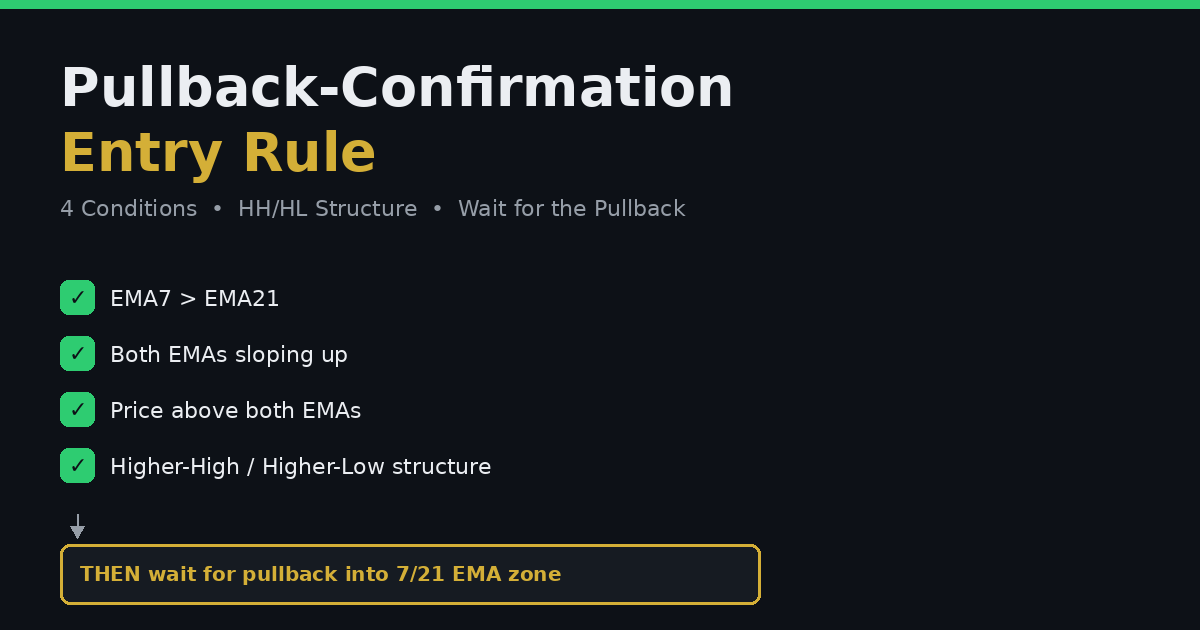
The stricter rule requires all of the following to be true simultaneously before a bullish setup is even eligible:
- EMA7 above EMA21 — the basic crossover condition, unchanged from the original system
- Both EMAs sloping upward — not just crossed, but both moving-average lines actively trending up, ruling out a crossover that happens while both lines are flat or rolling over
- Price trading above both EMAs — confirming the current price action, not just the moving averages, is on the bullish side
- Higher-high/higher-low market structure — actual swing-point evidence of an uptrend, independent of what the EMAs are doing
The bearish rule mirrors this exactly: EMA7 below EMA21, both EMAs sloping down, price below both EMAs, and lower-low/lower-high structure. Requiring all four conditions together — two EMA-based, two price-action-based — means the EMA signals and the actual market structure have to agree before a setup even qualifies, rather than trusting either one alone.
Then Wait for the Pullback
Even after all four conditions confirm a valid trend, the entry doesn't trigger immediately. Instead, the rule waits for a pullback into the 7/21 EMA zone before triggering a continuation entry. This solves a separate problem from trend validity: even a genuine, well-confirmed trend often means the best entry price already passed by the time all four conditions are visible on the chart. Chasing price immediately after confirmation means consistently buying (or selling) at a worse price than a trader who waits for the inevitable minor pullback that most trends produce along the way.
Why This Combination Matters More Than Either Piece Alone
Structure confirmation without a pullback requirement still risks poor entry timing — correctly identifying a strong uptrend doesn't mean the current price is a good place to buy into it. A pullback-entry rule without structure confirmation risks buying dips inside setups that were never a real trend to begin with — "the price pulled back to the EMA zone" means nothing if the broader structure was choppy in the first place. Combining both means the EA only looks for pullback entries inside setups that have already cleared a much higher bar for being a genuine trend.
The Trade-Off: Fewer Signals, Higher Bar
This rule set is deliberately more restrictive than the original crossover-only system — a meaningful number of setups that would have triggered under the simpler rule now get filtered out for failing the structure or slope conditions, or for never producing a valid pullback before the trend continued without one. That's the intended trade-off: fewer total trades in exchange for each remaining trade having cleared a stack of independent confirmations rather than a single crossed-EMA condition.
Related Reading
- From 3 Failed Hedging EAs to a Simple EMA Crossover: An MT5 Multi-Account Case Study
- Guaranteed-Profit Basket Closing: A Real-Time Opposite-Trade Safety Net for an MT5 EA
- Inside a Self-Learning MT5 EA's 8-Factor SMC Confidence Score (and a Learning Engine Bug)
- Grading Structure Breaks in an MT5 SMC EA: The V1.49 Structure Scoring Redesign


.png)
0 Comments